
PARIS, FR / ACCESS Newswire / July 29, 2026 / Artificial intelligence is rapidly moving beyond isolated pilot projects and experimental innovation labs. Across virtually every industry, organizations are deploying AI assistants, autonomous agents, intelligent workflows, and machine learning systems to support employees, automate decisions, improve customer experiences, and accelerate business operations.
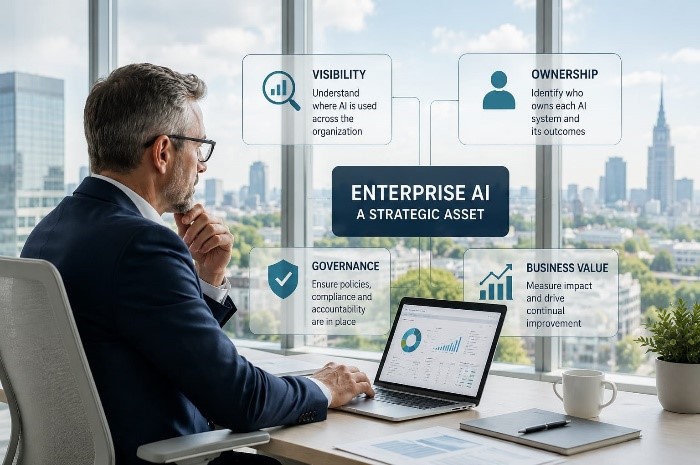
As adoption grows, enterprises are experiencing a fundamental shift. AI is no longer simply another software application added to the technology stack. It is becoming a new category of enterprise asset that actively contributes to productivity, operational performance, and long-term business value.
For decades, organizations have established governance models for their most important assets, including people, financial resources, applications, infrastructure, and enterprise data. Each has defined ownership, accountability, and performance management processes.
Enterprise AI increasingly requires the same operational discipline.
Unlike traditional software, AI systems can generate content, make recommendations, analyze information, interact with customers, and execute increasingly complex workflows with limited human intervention. As organizations deploy larger numbers of AI systems and autonomous agents, managing them becomes an operational challenge rather than simply a technology initiative.
Yet many executives still struggle to answer fundamental questions about their AI environments:
-
Where is AI being used across the organization?
-
Who owns each AI system?
-
Which AI agents have access to business information?
-
Which AI-powered workflows create measurable business value?
-
Can leadership demonstrate appropriate governance and accountability?
These questions are becoming more important as AI adoption spreads independently across departments. Marketing teams use generative AI to create content. Human resources integrate AI into recruitment processes. Finance departments automate forecasting. Software developers increasingly rely on AI coding assistants. Without centralized visibility, these initiatives often remain fragmented, making enterprise-wide oversight significantly more difficult.
The challenge extends well beyond regulatory compliance. Organizations cannot effectively govern technologies they cannot fully see or understand.
History offers a familiar pattern. Financial assets require accounting systems. IT assets require configuration management. Cybersecurity depends on continuous asset discovery and monitoring. Enterprise AI is now creating the need for its own operational management layer.
Without visibility, organizations cannot build a reliable inventory of AI systems.
Without inventory, ownership becomes unclear.
Without ownership, governance becomes inconsistent.
Without governance, demonstrating trust, accountability, and measurable business value becomes increasingly difficult.
This challenge will only grow as enterprises deploy more autonomous AI agents capable of supporting employees, interacting with customers, and participating directly in business operations. Rather than managing isolated software tools, organizations are beginning to manage an expanding digital workforce that requires visibility, ownership, and governance throughout its lifecycle.
Forward-looking organizations are increasingly recognizing that AI should be managed as a strategic enterprise asset rather than as a disconnected collection of applications adopted by individual teams.
As a result, a new category of enterprise platforms is emerging to provide organization-wide discovery, visibility, inventory, governance, ownership tracking, and evidence management. These capabilities help executives understand where AI exists, who is responsible for it, how it is being used, and whether governance practices are consistently applied across the enterprise.
For organizations beginning this journey, adopting an Enterprise AI Visibility Platform provides an important first step toward understanding where AI exists before attempting to govern it effectively.
Once visibility has been established, executives are in a far stronger position to evaluate governance maturity, clarify ownership, reduce operational risk, and measure the business value created by AI investments. Organizations can also benefit from conducting an AI Visibility Assessment to establish a baseline of AI adoption, identify unmanaged deployments and prioritize governance improvements before scaling enterprise initiatives.
The organizations that succeed over the coming decade are unlikely to be those that simply deploy the greatest number of AI tools. They will be the ones that understand where AI exists, manage it as a strategic enterprise asset, and continuously improve its governance, accountability, and business value over time.
Company Details
Company Name: Alterlayer
Contact Person: Mr Lud Point
Email: contact@alterlayer.com
Website: https://alterlayer.com/
SOURCE: Alterlayer
View the original press release on ACCESS Newswire


