
Daily capsule supplement combining twelve ingredients — including Saffron, studied in clinical trials for mood and cognitive function markers, and Huperzine-A, examined for acetylcholinesterase inhibition in published meta-analyses — alongside Bacopa monnieri, DMAE, Rhodiola Rosea, Ginkgo Biloba, Citicoline, Mucuna Pruriens, Turmeric Root, Phosphatidylserine, Gotu Kola, and Rosemary, formulated by Dr. Ryan Shelton NMD at Zenith Labs
Brain C-13, a twelve-ingredient daily capsule supplement formulated by Dr. Ryan Shelton NMD at Zenith Labs, combining Saffron and Huperzine-A as two primary ingredients alongside ten botanical, amino acid, and phospholipid compounds, available in 60-day, 90-day, and 180-day supply configurations.
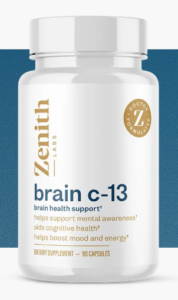
AURORA, Colorado, August 20, 2026 — Approximately 6.9 million Americans aged 65 and older are currently living with Alzheimer’s disease, according to the Alzheimer’s Association, making cognitive health one of the most active areas of dietary supplement development in North America. Zenith Labs has announced the commercial launch of Brain C-13, a twelve-ingredient capsule supplement formulated by Dr. Ryan Shelton, NMD, Director of Research at Zenith Labs. The formula enters the cognitive support supplement category with a dual-mechanism ingredient pairing: Saffron, which has been examined in randomized controlled trials for its relationship to mood and cognitive function markers, and Huperzine-A, which has been studied as a reversible acetylcholinesterase inhibitor — two mechanistically distinct research pathways addressed within a single formulation.
Brain C-13 is manufactured in a GMP-certified, FDA-audited facility in the United States and is available at brainclarity.net. The supplement is taken as three capsules daily — one with each meal. All active ingredients are individually identified on the product’s Supplement Facts panel. The manufacturer notes the formula contains gelatin capsule shells and is not suitable for strict vegans or vegetarians.
Product Overview
This press release reports the commercial entry of Brain C-13 into the U.S. cognitive support supplement market. Brain C-13 is a dietary supplement developed and marketed by Zenith Labs, a dietary supplement company based in Aurora, Colorado, operating under the direction of Dr. Ryan Shelton, NMD, Director of Research. The manufacturer has structured the formula around Saffron and Huperzine-A as its two primary ingredients, supplemented by ten additional compounds spanning Ayurvedic botanicals, East Asian herbal medicine, amino acid derivatives, and phospholipid nutrients.
Important note on research and product claims: The scientific citations in this press release describe independent research on individual ingredient compounds, conducted in separate laboratory or clinical settings under conditions unaffiliated with Zenith Labs. These studies examined the cited compounds in isolation or in specific formulations distinct from Brain C-13. The presence of an ingredient in Brain C-13 does not imply that the product will produce outcomes equivalent to or consistent with those reported in the cited studies. No clinical trial has evaluated the complete Brain C-13 formulation as a finished product. Zenith Labs does not claim that Brain C-13 produces the outcomes described in any cited study.
The manufacturer states that Brain C-13 is produced in a GMP-certified, FDA-audited facility in the United States. Under 21 CFR Part 111, dietary supplement manufacturers registered with the FDA are required to comply with current Good Manufacturing Practice regulations governing production standards, ingredient testing, quality control, and product labeling.
“Brain C-13 was formulated around two ingredients with distinct peer-reviewed research profiles. Saffron has been examined in multiple randomized controlled trials for its relationship to mood markers and cognitive function, including a 2013 meta-analysis in Human Psychopharmacology. Huperzine-A has been studied as a reversible inhibitor of acetylcholinesterase — the enzyme that breaks down acetylcholine in the synapse — with a 2013 PLOS ONE meta-analysis examining its relationship to cognitive function across randomized trials. The remaining ten ingredients were each selected based on published literature examining distinct neurological mechanisms: cholinergic support, cerebrovascular circulation, adaptogenic stress response, and cellular membrane phospholipid integrity. These are independent studies. Brain C-13 has not been evaluated in a clinical trial as a finished product, and no equivalence to any cited study outcome is claimed.”
— Dr. Ryan Shelton, NMD, Director of Research, Zenith Labs
Ingredient Overview
The following section lists the twelve disclosed ingredients of Brain C-13. Each entry cites independent published research that examined the respective compound in laboratory or clinical settings. All cited research was conducted under conditions unaffiliated with Zenith Labs and describes findings specific to the compound as studied — not to Brain C-13 as a finished product. No equivalence between cited study outcomes and Brain C-13’s effects is claimed or implied.
Saffron (Crocus sativus). A meta-analysis published in Human Psychopharmacology (Hausenblas, H.A., et al., 2013, “Saffron (Crocus sativus L.) and major depressive disorder: a meta-analysis of randomized clinical trials,” doi:10.1002/hup.2335) examined Saffron supplementation in adult subjects in relation to mood and cognitive function markers across multiple randomized controlled trials.
Huperzine-A. A meta-analysis published in PLOS ONE (Yang, G., et al., 2013, “Huperzine A for Alzheimer’s disease: a systematic review and meta-analysis of randomized clinical trials,” doi:10.1371/journal.pone.0074916) examined Huperzine-A in adult subjects in relation to cognitive function outcomes and acetylcholinesterase inhibition across multiple randomized controlled trials.
Bacopa monnieri. A systematic review published in the Journal of Ethnopharmacology (Kongkeaw, C., et al., 2014, “Meta-analysis of randomized controlled trials on cognitive effects of Bacopa monnieri extract,” doi:10.1016/j.jep.2013.12.044) examined Bacopa monnieri in adult subjects in relation to memory, attention, and cognitive processing outcomes across multiple randomized controlled trials.
DMAE (Dimethylaminoethanol). A review published in Free Radical Biology and Medicine (Zs.-Nagy, I., 1994, “The membrane hypothesis of aging: its relevance to recent progress in genetic research,” doi:10.1016/0891-5849(94)90177-5) examined DMAE’s mechanism of action in relation to cell membrane integrity and cholinergic pathway activity in adult subjects.
Rhodiola Rosea. A systematic review published in BMC Complementary and Alternative Medicine (Ishaque, S., et al., 2012, “Rhodiola rosea for physical and mental fatigue: a systematic review,” doi:10.1186/1472-6882-12-70) examined Rhodiola rosea in adult subjects in relation to mental fatigue, cognitive performance, and stress response markers.
Ginkgo Biloba. A meta-analysis published in Human Psychopharmacology (Tan, M.S., et al., 2015, “Efficacy and adverse effects of Ginkgo biloba for cognitive impairment and dementia: a systematic review and meta-analysis,” doi:10.1002/hup.2502) examined Ginkgo biloba in adult subjects in relation to cognitive function, memory, and cerebral circulation outcomes across multiple randomized controlled trials.
Citicoline (Cognizin®). A randomized controlled trial published in Psychopharmacology (McGlade, E., et al., 2012, “Improved attentional performance following citicoline administration in healthy adult women,” doi:10.1007/s00213-012-2966-9) examined citicoline in healthy adult female subjects in relation to attentional performance and cognitive function markers.
Mucuna Pruriens (Velvet Bean). A study published in Phytotherapy Research (Katzenschlager, R., et al., 2004, “Mucuna pruriens in Parkinson’s disease: a double blind clinical and pharmacological study,” doi:10.1002/ptr.1503) examined Mucuna pruriens extract — a natural source of L-DOPA precursors — in adult subjects in relation to dopaminergic and motor function outcomes.
Turmeric Root (Curcuma longa). A randomized controlled trial published in the American Journal of Geriatric Psychiatry (Small, G.W., et al., 2018, “Memory and brain amyloid and tau effects of a bioavailable form of curcumin in non-demented adults: a double-blind, placebo-controlled 18-month trial,” doi:10.1016/j.jagp.2017.10.010) examined bioavailable curcumin in non-demented adult subjects in relation to memory function and brain amyloid and tau markers over 18 months.
Phosphatidylserine. A systematic review published in Nutrients (Glade, M.J., & Smith, K., 2015, “Phosphatidylserine and the human brain,” doi:10.3390/nu7010068) examined phosphatidylserine in adult subjects in relation to cognitive function, memory, and neuronal membrane integrity markers across multiple clinical studies.
Gotu Kola (Centella asiatica). A randomized controlled trial published in the Journal of Ethnopharmacology (Wattanathorn, J., et al., 2008, “Positive modulation of cognition and mood in the healthy elderly volunteer following the administration of Centella asiatica,” doi:10.1016/j.jep.2007.10.038) examined Centella asiatica in healthy elderly adult subjects in relation to cognitive function and mood markers.
Rosemary (Rosmarinus officinalis). A study published in Therapeutic Advances in Psychopharmacology (Moss, M., & Oliver, L., 2012, “Plasma 1,8-cineole correlates with cognitive performance following exposure to rosemary essential oil aroma,” doi:10.1177/2045125312436573) examined Rosemary aroma compound exposure in adult subjects in relation to cognitive performance and working memory markers.
Availability and Purchasing
Brain C-13 is available through Zenith Labs’ authorized retail portal at brainclarity.net. Three supply configurations are available: a two-bottle package (60-day supply) at $59 per bottle for a total of $118 plus $9.95 U.S. shipping; a three-bottle package (90-day supply) at $49 per bottle for a total of $147 plus $9.95 U.S. shipping; and a six-bottle package (180-day supply) at $33 per bottle for a total of $198 with free U.S. shipping. Three- and six-bottle orders include two bonus digital guides. All purchases are a one-time charge with no subscription, auto-ship, or hidden fees.
All purchases are backed by a 180-day money-back guarantee. Product support is available at support@zenithlabs.com or by telephone at (800) 928-1184. Zenith Labs is located at 19655 E 35th Dr, Suite 100, Aurora, CO 80011. U.S. orders ship within 5–7 business days.
Quality and Manufacturing
Brain C-13 is manufactured in a GMP-certified, FDA-audited facility in the United States. Under 21 CFR Part 111, the manufacturer is required to comply with current Good Manufacturing Practice regulations covering production standards, ingredient testing, quality control, and accurate product labeling. All active ingredients are individually identified on the product’s Supplement Facts panel. The formula contains gelatin capsule shells.
Usage Guidance
Brain C-13 is intended for adult use as a daily dietary supplement. The recommended serving is three capsules daily, preferably one with each meal. The formula is not suitable for strict vegans or vegetarians due to gelatin capsule shells. Individuals who are pregnant, nursing, or managing existing medical conditions should consult a qualified healthcare professional before use.
Individuals taking prescription cholinesterase inhibitors — such as donepezil, rivastigmine, or galantamine — should consult their physician before use, as Huperzine-A may produce additive effects with these medications. Individuals taking medications for cardiac conditions should also seek medical advice prior to use. Individual results may vary.
These statements have not been evaluated by the Food and Drug Administration. This product is not intended to diagnose, treat, cure, or prevent any disease. Individual results may vary.
Affiliate Disclosure: This press release may contain affiliate links through which the publisher may receive compensation if a purchase is made. This disclosure is made in accordance with the Federal Trade Commission’s guidelines on endorsements and testimonials (16 CFR Part 255).
About Zenith Labs
Zenith Labs is a dietary supplement company based in Aurora, Colorado, operating under the direction of Dr. Ryan Shelton, NMD, Director of Research. Brain C-13 is a twelve-ingredient cognitive support capsule supplement combining Saffron, Huperzine-A, Bacopa monnieri, DMAE, Rhodiola Rosea, Ginkgo Biloba, Citicoline, Mucuna Pruriens, Turmeric Root, Phosphatidylserine, Gotu Kola, and Rosemary, manufactured in a GMP-certified, FDA-audited U.S. facility with a 180-day money-back guarantee. For more information, visit brainclarity.net.
Media Contact
Dr. Ryan Shelton, NMD
Director of Research, Zenith Labs
support@zenithlabs.com
800800 928-1184
19655 E 35th Dr, Suite 100, Aurora, CO 80011
Author: Dr. Ryan Shelton, NMD, Zenith Labs — @ZenithLabs
Company: @ZenithLabs
Distributed By: XPR Media — @XPR_Syndicate
The post Brain C-13 Reviews: Zenith Labs Launches Dual-Mechanism Cognitive Support Supplement Brain C-13 Combining Saffron and Huperzine-A in U.S. Market appeared first on 24 Health Times.


