Global Canned Soup Market Benefits From Rising Demand for Convenient, Shelf-Stable Foods, Product Innovation, and Expanding Retail and Online Distribution
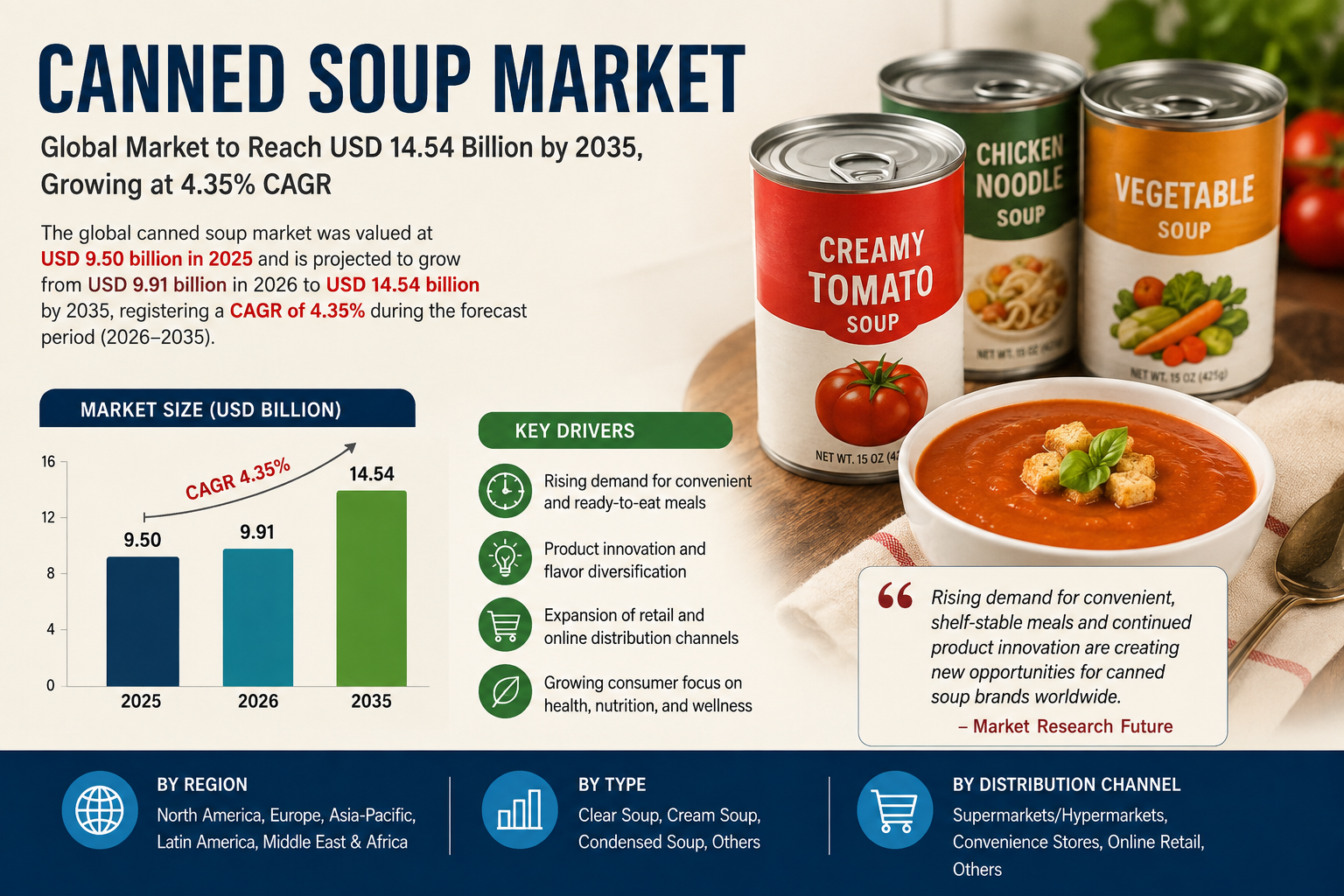
NEW YORK, NY, UNITED STATES, August 24, 2026 /EINPresswire.com/ — The global Canned Soup Market is entering a sustained period of expansion as consumers increasingly seek convenient, affordable, shelf-stable meal solutions that fit busy lifestyles. According to Market Research Future, the global canned soup market was valued at USD 9.50 billion in 2025 and is projected to increase from USD 9.91 billion in 2026 to USD 14.54 billion by 2035, registering a compound annual growth rate (CAGR) of 4.35% during the forecast period from 2026 to 2035.
The market’s projected growth reflects the continued relevance of canned soup across household consumption, convenience-oriented food purchasing, foodservice applications, and emergency or pantry-stocked meals. Manufacturers are responding to evolving consumer preferences through product diversification, new flavors, convenient packaging formats, nutritional reformulation, premium offerings, and expanded distribution through supermarkets, convenience stores, and online grocery channels.
Canned Soup Market Positioned for Steady Long-Term Expansion
Canned soup remains an established category within the global packaged food industry because it combines convenience, relatively long shelf life, ease of preparation, and accessibility. Unlike fresh or fully prepared meal alternatives that may require refrigeration or extensive cooking, canned soup can be stored for extended periods and prepared with minimal effort.
The market’s movement from USD 9.50 billion in 2025 to a projected USD 14.54 billion by 2035 represents an increase of approximately USD 5.04 billion over the forecast period. With a 4.35% CAGR, the category is expected to experience consistent rather than short-term expansion, supported by changing household routines, urbanization, retail accessibility, and continued demand for convenient food products.
The category also benefits from its versatility. Consumers can purchase canned soup as a standalone meal, a quick lunch or dinner option, a cooking ingredient, or a pantry staple. Manufacturers can serve multiple consumer groups through variations in flavor, texture, nutritional positioning, portion size, packaging, and preparation format.
Get Full PDF Sample Copy of Report: (Including Full TOC, List of Tables & Figures, Chart) @ https://www.marketresearchfuture.com/sample_request/22586
Convenience Remains a Major Market Growth Driver
Convenience continues to be one of the most important forces shaping the canned soup industry.
Modern consumers frequently balance professional responsibilities, commuting, family commitments, and increasingly flexible work schedules. This environment creates demand for foods that reduce preparation time without eliminating the opportunity for a warm and familiar meal.
Canned soup offers a straightforward proposition: it can generally be stored without refrigeration before opening, requires limited preparation, and can be consumed at home or incorporated into broader meal occasions. These characteristics make the product particularly relevant to time-conscious households.
The category also benefits from its role as a dependable pantry product. Consumers may purchase canned soup in advance and keep it available for days when they do not have the time, ingredients, or inclination to prepare food from scratch.
Product Innovation Broadens Consumer Appeal
While traditional varieties remain important, manufacturers are increasingly using product innovation to expand the appeal of canned soup.
Product development can include new flavor combinations, regional recipes, vegetable-forward formulations, premium ingredients, spicy varieties, cream-based recipes, clear soups, condensed products, and ready-to-serve formats.
Innovation is also increasingly focused on nutritional expectations. Consumers are paying greater attention to ingredient lists, sodium levels, protein content, calories, and overall nutritional composition. As a result, manufacturers have opportunities to develop products positioned around specific dietary preferences and changing perceptions of healthier convenience foods.
The evolution of the category allows canned soup to address both traditional comfort-food demand and newer consumer expectations around transparency, nutrition, variety, and quality.
Market Segmentation Creates Multiple Growth Opportunities
The global canned soup market can be examined across several dimensions, including soup type, taste profile, packaging size, distribution channel, and product format.
By soup type, the market includes categories such as clear soup, cream soup, condensed soup, and other formulations. Different soup types appeal to different eating occasions and regional preferences, giving manufacturers multiple avenues for product differentiation.
By taste profile, offerings can include savory, sweet, spicy, and other flavor profiles. Traditional savory varieties remain central to the category, while manufacturers have opportunities to introduce more distinctive flavors that respond to consumers seeking variety and international culinary experiences.
By packaging size, products can be positioned in small, medium, and large formats. Smaller packages can support individual consumption and portion control, while larger formats may appeal to families or consumers purchasing pantry staples.
By format, the category includes ready-to-serve and condensed products, among other formats. Ready-to-serve soup emphasizes convenience, while condensed soup can provide consumers with flexibility in preparation and use as a cooking ingredient.
By distribution channel, supermarkets and hypermarkets continue to provide important shelf space and consumer access, while convenience stores and online retail are expanding the number of ways consumers can purchase packaged soup.
Supermarkets and Hypermarkets Remain Important Retail Channels
Traditional grocery retail remains a critical component of the canned soup supply chain.
Supermarkets and hypermarkets provide broad product visibility, extensive shelf space, promotional opportunities, and access to large consumer populations. Canned soup can benefit from its compatibility with conventional grocery merchandising because consumers often purchase it alongside other pantry staples and household food products.
Retailers also provide manufacturers with opportunities to introduce multipacks, promotional bundles, private-label products, premium ranges, and new flavors.
At the same time, online grocery is changing how consumers discover and purchase packaged food. Digital retail enables shoppers to compare products, read nutritional information, review ingredients, evaluate prices, and purchase pantry products without visiting a physical store.
The expansion of e-commerce therefore provides canned soup manufacturers with an additional channel for reaching consumers and supporting repeat purchases.
Online Retail Opens New Routes to Market
Online grocery and e-commerce platforms are becoming increasingly relevant to shelf-stable packaged food categories.
Canned soup is particularly suitable for online distribution because of its relatively long shelf life and ability to be shipped as a packaged pantry product. Digital channels can also support larger basket sizes through multipacks and subscription-style purchasing.
For manufacturers, online retail can provide valuable opportunities to test new products, reach niche consumer segments, and communicate product attributes that may be difficult to convey through limited physical shelf space.
Digital marketing can further connect canned soup brands with consumers interested in convenience, meal planning, budget-conscious purchasing, nutrition, and recipe inspiration.
Affordability Supports Category Resilience
Economic conditions can also influence consumer purchasing behavior within the packaged food sector.
When household budgets become more constrained, consumers may look for affordable meal solutions that reduce food waste and minimize preparation costs. Canned soup can benefit from this environment because it can serve as a relatively accessible pantry meal and can also be incorporated into recipes using additional ingredients.
At the same time, the market is not limited to value-oriented products. Premiumization provides another route for growth, with manufacturers able to differentiate products through ingredients, recipes, packaging, positioning, and perceived quality.
This creates a broad market spectrum extending from economical everyday products to premium soups targeting consumers willing to pay more for specialized ingredients, distinctive flavors, or enhanced nutritional characteristics.
Health and Nutrition Trends Influence Product Development
Consumer attitudes toward health and nutrition are increasingly influencing packaged food purchasing decisions.
Canned soup manufacturers are therefore exploring opportunities to improve nutritional profiles while retaining the taste, convenience, affordability, and shelf stability expected from the category.
Potential areas of innovation include reduced-sodium formulations, vegetable-rich recipes, higher-protein options, clean-label positioning, plant-based recipes, and formulations designed around particular dietary preferences.
Sodium remains an important consideration for the industry because soup products have traditionally relied on salt as a flavor component and preservative aid. Increasing consumer awareness and evolving labeling requirements in various markets can encourage manufacturers to invest in reformulation and clearer nutritional communication.
The result is a gradual evolution of canned soup from a purely convenience-oriented product toward a more diverse category capable of addressing both convenience and nutritional considerations.
Plant-Based and Specialty Offerings Expand the Addressable Market
The expansion of plant-based eating and interest in alternative diets presents another opportunity for canned soup manufacturers.
Vegetable soups, lentil soups, bean-based recipes, mushroom formulations, and other plant-forward products can appeal to consumers seeking more plant-based foods without requiring them to prepare meals from individual ingredients.
Manufacturers can also develop products around vegetarian, vegan, gluten-conscious, organic, or other specialty positioning where appropriate and supported by local regulatory requirements.
These offerings can expand the consumer base beyond traditional soup buyers and help brands participate in broader food trends surrounding plant-based eating, ingredient transparency, and dietary flexibility.
Regional Markets Present Diverse Growth Opportunities
The global canned soup industry encompasses mature markets as well as emerging economies, each with distinct consumption patterns, culinary traditions, retail structures, and purchasing behaviors.
North America remains an important market because of established packaged-food consumption, extensive supermarket networks, strong brand recognition, and widespread familiarity with canned soup.
Europe also represents a significant opportunity, supported by established food retail infrastructure and diverse consumer preferences. Manufacturers can leverage regional flavors and localized recipes to address differences between national markets.
Asia-Pacific offers long-term growth potential as urbanization, changing lifestyles, expanding retail infrastructure, and rising consumer exposure to packaged convenience foods create new opportunities. Local taste adaptation is likely to remain important in this region because soup consumption patterns and flavor preferences vary considerably between countries.
Markets across Latin America, the Middle East, and Africa can similarly provide opportunities as modern retail, packaged-food distribution, and consumer demand for convenient products continue to develop.
Sustainability and Packaging Remain Strategic Considerations
Packaging is another area receiving increasing attention across the packaged food industry.
Canned packaging provides important functional advantages, including durability, protection from external contamination, extended shelf life, and efficient storage. These characteristics can help reduce dependence on cold-chain infrastructure and support long-distance distribution.
At the same time, sustainability expectations are encouraging food manufacturers and packaging suppliers to examine material efficiency, recyclability, manufacturing processes, transportation requirements, and end-of-life recovery.
For canned soup producers, continued improvements in packaging efficiency and responsible sourcing can contribute to brand differentiation while addressing growing expectations from retailers, regulators, investors, and consumers.
Competitive Landscape Encourages Innovation
The canned soup market remains competitive, with established multinational food companies, regional producers, private-label manufacturers, and emerging brands competing for consumer attention.
Competition is increasingly influenced by more than price alone. Brands are differentiating through flavor innovation, packaging, nutritional positioning, ingredient quality, convenience, sustainability messaging, and digital engagement.
Private-label products can also play an important role by giving retailers greater control over pricing and product positioning while offering consumers additional choices.
As the market expands, manufacturers are likely to continue investing in research and development, production efficiency, supply-chain optimization, brand building, and channel expansion.
Strategic partnerships, new product launches, regional expansion, acquisitions, and investments in manufacturing capacity may also shape the competitive environment through 2035.
Key Trends Shaping the Canned Soup Market Through 2035
Several trends are expected to influence the market over the coming decade:
Convenience-first consumption: Busy lifestyles will continue supporting demand for easy-to-prepare meals.
Health-oriented reformulation: Consumers’ increasing attention to sodium, ingredients, protein, vegetables, and nutritional value will encourage product innovation.
Flavor diversification: Brands will introduce more regional, ethnic, spicy, premium, and unconventional flavors to attract consumers seeking variety.
Plant-based expansion: Vegetable, legume, and other plant-forward formulations will create new opportunities.
Premiumization: Higher-quality ingredients, distinctive recipes, and premium packaging can support higher-value product segments.
E-commerce growth: Digital grocery channels will provide new routes to consumers and enable convenient repeat purchasing.
Private-label competition: Retailer-owned brands will continue competing with established manufacturers on value and quality.
Sustainable packaging: Packaging efficiency and recyclability will become increasingly relevant to purchasing and corporate sustainability strategies.
Future Outlook
The projected increase from USD 9.50 billion in 2025 to USD 14.54 billion by 2035 demonstrates the continuing commercial potential of the global canned soup category. With a 4.35% CAGR from 2026 to 2035, the market is positioned for steady expansion rather than a short-lived surge.
Future growth will depend on manufacturers’ ability to balance convenience, affordability, taste, nutrition, innovation, and sustainability. Companies that successfully respond to changing consumer expectations while maintaining reliable product quality and distribution are likely to be well positioned to capture emerging opportunities.
The market’s evolution also demonstrates that canned soup remains adaptable. Its established role as a shelf-stable pantry product provides a strong foundation, while new flavors, formats, nutritional profiles, packaging solutions, and digital distribution channels can broaden its relevance for future generations of consumers.
As consumers continue to prioritize convenient meal solutions without abandoning expectations around quality and nutrition, canned soup is expected to remain an important component of the global packaged food landscape.
Discover Related Research Reports By Market Research Future:
Canned Beef Market
https://www.marketresearchfuture.com/reports/canned-beef-market-26963
Canned Tuna Market
https://www.marketresearchfuture.com/reports/canned-tuna-market-10335
Canned Vegetables Market
https://www.marketresearchfuture.com/reports/canned-vegetables-market-1888
Canned Seafood Market
https://www.marketresearchfuture.com/reports/canned-seafood-market-6703
Sagar Kadam
Market Research Future
+1 628-258-0071
email us here
Legal Disclaimer:
EIN Presswire provides this news content “as is” without warranty of any kind. We do not accept any responsibility or liability
for the accuracy, content, images, videos, licenses, completeness, legality, or reliability of the information contained in this
article. If you have any complaints or copyright issues related to this article, kindly contact the author above.

Media gallery