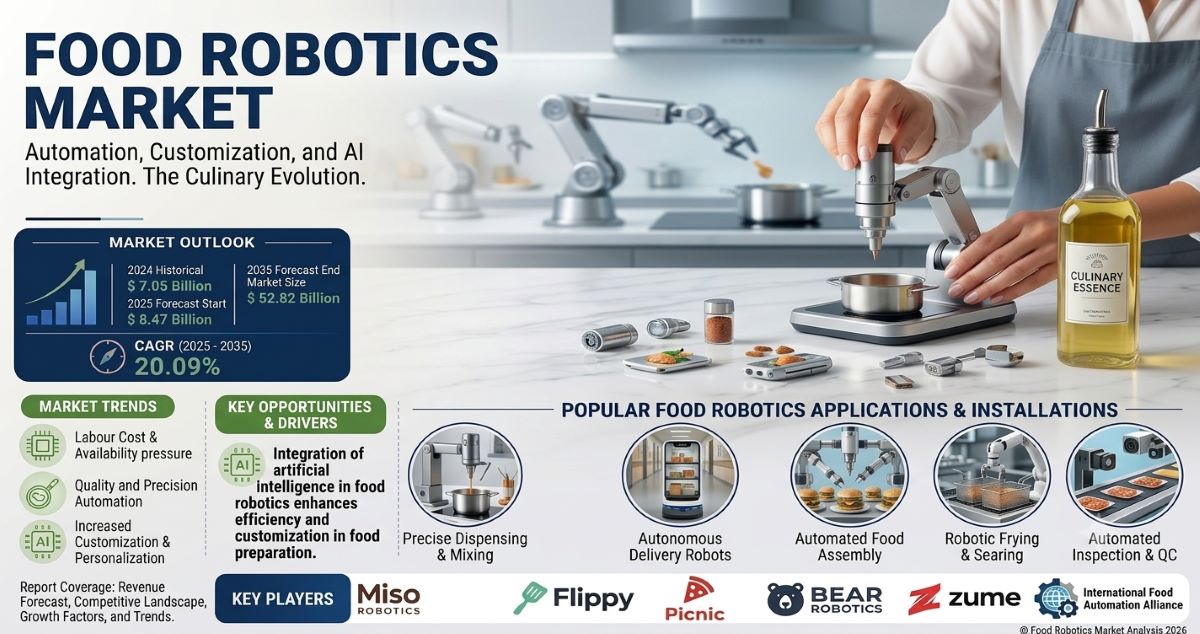
Food Robotic Market is transforming with advanced automation and rising demand for greater efficiency, speed, and precision across food production and service.
NEW YORK, NY, UNITED STATES, August 24, 2026 /EINPresswire.com/ — The global Food Robotic Market Growth is entering a transformative phase as food manufacturers, restaurants, foodservice operators, and distributors increasingly adopt robotics to improve productivity, consistency, safety, and operational efficiency. According to the latest industry analysis, the market was valued at approximately USD 7.049 billion in 2024 and is projected to reach USD 8.465 billion in 2025. It is expected to expand to USD 52.82 billion by 2035, representing a 20.09% compound annual growth rate (CAGR) from 2025 to 2035.
The accelerating adoption of robotics reflects a broader shift within the global food industry. Businesses are facing higher labor expenses, workforce shortages, rising expectations for faster service, and growing pressure to maintain consistent quality. At the same time, advances in artificial intelligence, machine learning, sensors, automation software, and connected systems are making food robots increasingly capable of performing tasks that previously required substantial manual intervention. These developments are creating new opportunities across food processing, packaging, preparation, cooking, serving, and delivery.
Food Robotics Transforming Modern Food Operations:
Food robotics refers to the use of robotic systems, automation, artificial intelligence, sensors, and machine vision across various stages of food production and service. Unlike traditional industrial automation, food robotics must operate in complex environments involving ingredients with different shapes, sizes, textures, weights, temperatures, and handling requirements. Robotic systems can perform repetitive tasks such as sorting, picking, processing, packing, assembling, palletizing, cooking, and serving with consistent accuracy and speed. In foodservice operations, robotics can also support kitchen preparation and customer-facing activities, helping businesses improve operational efficiency while allowing employees to focus on creative, supervisory, and customer-oriented responsibilities. As labor availability, productivity requirements, and demand for consistent food quality continue to influence the industry, automated solutions are becoming increasingly relevant across commercial food operations.
Artificial intelligence is further enhancing food robotics by enabling machines to analyze information, recognize ingredients, monitor processes, and adjust activities according to changing conditions. Machine vision and intelligent software can help robotic systems identify objects and perform tasks with greater flexibility than conventional fixed automation. Another emerging opportunity is personalized food preparation. Consumers are increasingly seeking meals that match individual dietary preferences, portion requirements, nutritional goals, and convenience expectations. By combining robotics with intelligent software, food businesses can achieve more precise ingredient handling, standardized preparation, and customized production. These developments are creating new possibilities for efficient, flexible, and technology-driven food operations.
Rising Automation Creates Strong Business Momentum:
One of the key factors supporting the Food Robotic Market is the growing need for automation across food preparation, processing, packaging, and service operations. Food businesses increasingly focus on improving productivity, speed, consistency, and operational efficiency while managing costs. Labor availability and rising employment expenses are also encouraging manufacturers, restaurants, and foodservice operators to explore robotic solutions for repetitive and time-sensitive activities. Robots can perform standardized tasks with precision and consistency, helping businesses maintain production and service continuity while allowing employees to focus on activities that require judgment, creativity, and customer interaction. As automation becomes more accessible, businesses of different sizes are exploring robotics to improve workflow efficiency and manage demanding operational requirements.
The growing adoption of human-machine collaboration is further shaping the development of food robotics. Rather than completely replacing human workers, many robotic systems are designed to work alongside employees and assist with physically repetitive or precision-oriented tasks. Collaborative robots, in particular, can support flexible automation within existing work environments, making them attractive to businesses that want to modernize operations without extensive restructuring. Advances in sensors, artificial intelligence, machine vision, and intelligent control systems are also improving robotic capabilities. These developments are helping the industry move beyond basic mechanical automation toward smarter, more adaptable food production and service environments, creating new opportunities for efficiency and innovation.
Get Full PDF Sample Copy of Report: (Including Full TOC, List of Tables & Figures, Chart) @
https://www.marketresearchfuture.com/sample_request/30540
Artificial Intelligence Opens New Opportunities:
Artificial intelligence is emerging as a major opportunity in food robotics, enabling robotic systems to become more adaptive, efficient, and responsive. AI-powered robots can recognize ingredients, interpret production conditions, monitor processes, and optimize workflows using real-time operational data. This technology can also support greater customization in food preparation by adjusting portions, ingredients, cooking temperatures, preparation sequences, and processing times according to specific requirements. Such capabilities can help food businesses address changing consumer preferences while maintaining consistency and operational efficiency. As AI technologies continue to develop, their integration with robotic platforms could create new possibilities across food processing, preparation, packaging, and service applications.
Machine learning and computer vision further strengthen the capabilities of food robotic systems. Machine learning allows robots to analyze historical and real-time information, identify patterns, improve scheduling, optimize resource utilization, and support quality monitoring. Meanwhile, computer vision enables robots to recognize differences in ingredients, shapes, sizes, colors, and product conditions, making it valuable for sorting, picking, inspection, and quality-control tasks. The convergence of AI, robotics, machine vision, sensors, and connected software is gradually moving the food industry beyond basic mechanical automation toward intelligent, flexible, and data-driven production and service environments. This transformation can also help businesses improve productivity, consistency, and responsiveness while supporting increasingly automated food operations.
Food Processing Remains a Major Application Area:
Food processing is a major application area for robotic technology, as many facilities involve repetitive and precision-based tasks that are suitable for automation. Robotic systems can support activities such as sorting, handling, packaging, assembly, inspection, and palletizing while delivering consistent performance. Automation helps manufacturers improve production efficiency, minimize errors, and maintain uniform quality across repetitive workflows. Programmable robots can perform precise movements repeatedly, making them valuable in high-volume processing environments where reliability and accuracy are important. Robotics can also contribute to food safety by reducing unnecessary human contact with products during selected processing stages. When combined with sanitation protocols, monitoring technologies, and quality controls, automated systems can help maintain controlled production environments. Ongoing advancements in sensors, artificial intelligence, and machine vision are further expanding robotic capabilities, enabling systems to manage diverse ingredients, product formats, and increasingly complex food-processing requirements efficiently and consistently.
Food Service Emerges as a High-Potential Growth Area:
While food processing remains a well-established application for robotics, foodservice is emerging as a promising area for automation. Restaurants, catering businesses, and other foodservice operators are adopting robotic solutions to improve speed, consistency, efficiency, and customer experiences. These systems can assist with food preparation, cooking, order management, delivery, and selected service functions, helping businesses streamline workflows and reduce bottlenecks during busy periods. Growing consumer demand for convenient and faster food services is further encouraging the adoption of robotic technologies, particularly in high-volume environments where efficient order fulfillment is essential. Robotics can also contribute to standardized food preparation by performing predefined tasks with consistent movements and operating parameters. This capability may help restaurant chains maintain uniform standards across multiple locations. However, automation is unlikely to completely replace human involvement. Instead, successful foodservice models may combine robotics with employees who oversee operations, engage with customers, manage exceptions, and perform flexible tasks requiring judgment, creativity, and adaptability, creating a balanced and efficient service environment.
Fully Automated Systems Gain Importance:
The market is also segmented according to the degree of automation, including semi-automated and fully automated systems. Fully automated solutions hold a strong position because they can support high-throughput operations with limited human intervention.
Large food manufacturers with substantial production volumes may find fully automated systems particularly attractive because they can connect several stages of a workflow. Robotics can work together with sensors, software, conveyor systems, and other automation technologies to create integrated production environments.
Semi-automated systems, however, provide an important pathway for businesses that may not be ready for complete automation. Smaller operators can introduce robotic assistance in selected stages while retaining human involvement in other activities.
This gradual approach can help organizations evaluate performance, train employees, understand maintenance requirements, and determine where additional automation could deliver the greatest operational benefits.
Regional Landscape Shows Broad Adoption Potential:
North America currently represents the largest regional market for food robotics. The region benefits from advanced technology adoption, significant investment in automation, rising labor costs, and growing interest in robotic foodservice applications. The United States remains a major contributor, supported by an established ecosystem of technology companies and robotics innovators.
Europe is also developing as an important market, supported by demand for automated food production, stringent food safety expectations, and established industrial capabilities. Germany, France, and the United Kingdom are among the notable markets within the region, while continued research and development can contribute to further adoption.
Asia-Pacific is positioned as a rapidly expanding region. Urbanization, changing consumer lifestyles, workforce considerations, and increasing technology adoption are encouraging restaurants and food manufacturers to explore automation. China and Japan represent significant markets, while other Asian economies may provide additional opportunities as foodservice and manufacturing infrastructure develops.
South America offers emerging opportunities as businesses modernize food production and service operations. The Middle East and Africa also present potential, particularly as investments in foodservice infrastructure and advanced technologies increase. However, adoption across these regions may vary depending on investment levels, regulatory conditions, technical infrastructure, and workforce capabilities.
Market Segment Insights:
By Type:
Articulated robots dominate due to their flexibility, precision, and ability to handle complex tasks such as packaging, assembly, and palletizing. Collaborative robots (cobots) are gaining momentum because they can safely work alongside employees and are easier to deploy, particularly for small and medium-sized businesses. SCARA robots are also emerging for high-speed, precision-focused applications.
By Application:
Food processing remains the leading application, supported by widespread automation in sorting, handling, packaging, and preparation. Food service is expanding rapidly as restaurants and catering businesses adopt robotics to improve cooking, order handling, delivery, and service efficiency.
By End User:
Food and beverage manufacturers lead adoption because of their large-scale production requirements and focus on efficiency, consistency, and labor optimization. Restaurants represent a growing segment as operators increasingly use robotics to streamline workflows, manage orders, and enhance customer service.
By Payload Capacity:
The 10–50 kg category leads due to its suitability for common food handling, sorting, packaging, and assembly activities. Meanwhile, 50–150 kg robots are gaining traction as larger facilities seek greater capacity, productivity, and automation capabilities.
By Degree of Automation:
Fully automated systems dominate due to their ability to deliver high productivity, consistency, and reduced manual intervention. Semi-automated solutions are growing as businesses seek flexible and cost-effective ways to gradually integrate robotics into existing operations.
Key Players and Competitive Insights:
The Food Robotic Market features a competitive mix of established technology companies and emerging innovators. Miso Robotics, Zume, and SoftBank Robotics are among the notable participants, with strategies centered on AI-powered automation, delivery solutions, customer interaction, and advanced robotics. Competition is increasingly focused on combining robotics with AI, software, sensors, analytics, and connectivity to improve foodservice efficiency and customer experiences.
Companies are also strengthening their supply chains, optimizing production, and developing strategic partnerships to improve scalability and reduce operational costs. The market remains moderately fragmented, creating opportunities for both established players and startups to introduce specialized solutions for different food industry applications.
▪️Miso Robotics
▪️Flippy
▪️Picnic
▪️Bear Robotics
▪️Zume
▪️Savioke
▪️Robot Coupe
▪️Kitchbot
▪️SoftBank Robotics.
Innovation is increasingly focused on integrated food robotics that combine artificial intelligence, sensors, software, connectivity, analytics, and automation to improve efficiency, accuracy, flexibility, and decision-making. Strategic partnerships between robotics providers, foodservice operators, manufacturers, and technology companies are also becoming important for product development, testing, customization, deployment, and expansion. As competition intensifies, companies are differentiating through reliability, safety, easy integration, maintenance support, software intelligence, adaptability, and cost efficiency. Providers capable of delivering scalable and practical automation solutions that demonstrate measurable operational benefits are expected to strengthen their position as food businesses increasingly embrace advanced robotics.
Challenges That Could Influence Adoption:
Despite strong opportunities, food robotics faces several challenges. Initial investment requirements can be significant, particularly for fully automated systems and large-scale installations. Businesses must consider equipment costs, software integration, employee training, maintenance, and facility modifications.
Food environments can also be technically challenging. Ingredients vary in shape, texture, temperature, moisture, and consistency. A robotic system that performs effectively in one environment may require significant customization for another.
Integration with existing infrastructure can create another hurdle. Manufacturers and restaurants may operate legacy equipment that was not originally designed to communicate with advanced robotic systems. Successful deployment therefore requires careful planning and compatibility assessment.
Workforce transformation is also an important consideration. Employees may need training to operate, supervise, troubleshoot, and maintain robotic equipment. Organizations that invest in skills development can be better positioned to capture the benefits of automation.
Future Outlook:
The future of food robotics will likely be shaped by increasingly intelligent and adaptable systems. AI-powered robots could move beyond repetitive mechanical activities toward decision-supported operations involving quality inspection, workflow optimization, customization, and predictive maintenance.
Another major opportunity lies in expanding robotics beyond large industrial facilities. As systems become more flexible and scalable, smaller food manufacturers, restaurants, supermarkets, and foodservice operators may gain greater access to automation.
The convergence of robotics with AI, IoT, cloud platforms, machine vision, analytics, and automation software could create connected food-production ecosystems. Such systems may allow operators to monitor performance, identify inefficiencies, adjust workflows, and make more informed operational decisions.
The long-term direction suggests that food robotics will become an increasingly integrated component of food production and service rather than a standalone technology. Businesses that strategically combine human expertise with intelligent automation may be better positioned to improve efficiency while maintaining quality and customer experience.
Frequently Asked Questions?
1. What is the projected size of the Food Robotic Market by 2035?
The Food Robotic Market is projected to reach USD 52.82 billion by 2035, compared with approximately USD 7.049 billion in 2024. The forecast reflects the accelerating adoption of robotic technologies across food processing, packaging, preparation, service, and related applications.
2. What is driving the expansion of food robotics?
Key factors include rising labor costs, workforce shortages, increasing demand for operational efficiency, technological improvements in AI and machine learning, food safety requirements, and growing interest in sustainable production. These factors are encouraging food businesses to automate repetitive and precision-dependent activities.
3. Which applications are covered by food robotics?
The industry includes robotics applications across food processing, food packaging, and food service. Processing includes activities such as handling and sorting, packaging involves automated packing and related operations, while food service includes robotic assistance in preparation, cooking, serving, and delivery-related workflows.
4. How will artificial intelligence influence food robotics?
Artificial intelligence can make food robots more adaptable by improving recognition, decision-making, process monitoring, customization, and workflow optimization. AI-enabled systems can potentially respond to variations in ingredients and operating conditions, helping businesses move from fixed automation toward more flexible and intelligent robotic operations.
Discover Related Research Reports By Market Research Future:
Food Delivery Service Market:
https://www.marketresearchfuture.com/reports/food-delivery-service-market-24739
Online Food Delivery Services Market:
https://www.marketresearchfuture.com/reports/online-food-delivery-services-market-25673
Functional Foods Beverage Market:
https://www.marketresearchfuture.com/reports/functional-foods-beverage-market-26915
Dinner Ready To Eat Food Market:
https://www.marketresearchfuture.com/reports/dinner-ready-to-eat-food-market-27122
Artificial Intelligence In Food And Beverages Market:
Market Research Future
Market Research Future
+1 855-661-4441
email us here
Legal Disclaimer:
EIN Presswire provides this news content “as is” without warranty of any kind. We do not accept any responsibility or liability
for the accuracy, content, images, videos, licenses, completeness, legality, or reliability of the information contained in this
article. If you have any complaints or copyright issues related to this article, kindly contact the author above.

Media gallery