
Originally Posted On: https://www.ucanpack.com/blog/post/how-to-choose-the-right-flute-for-cardboard-boxes-carrying-heavy-items
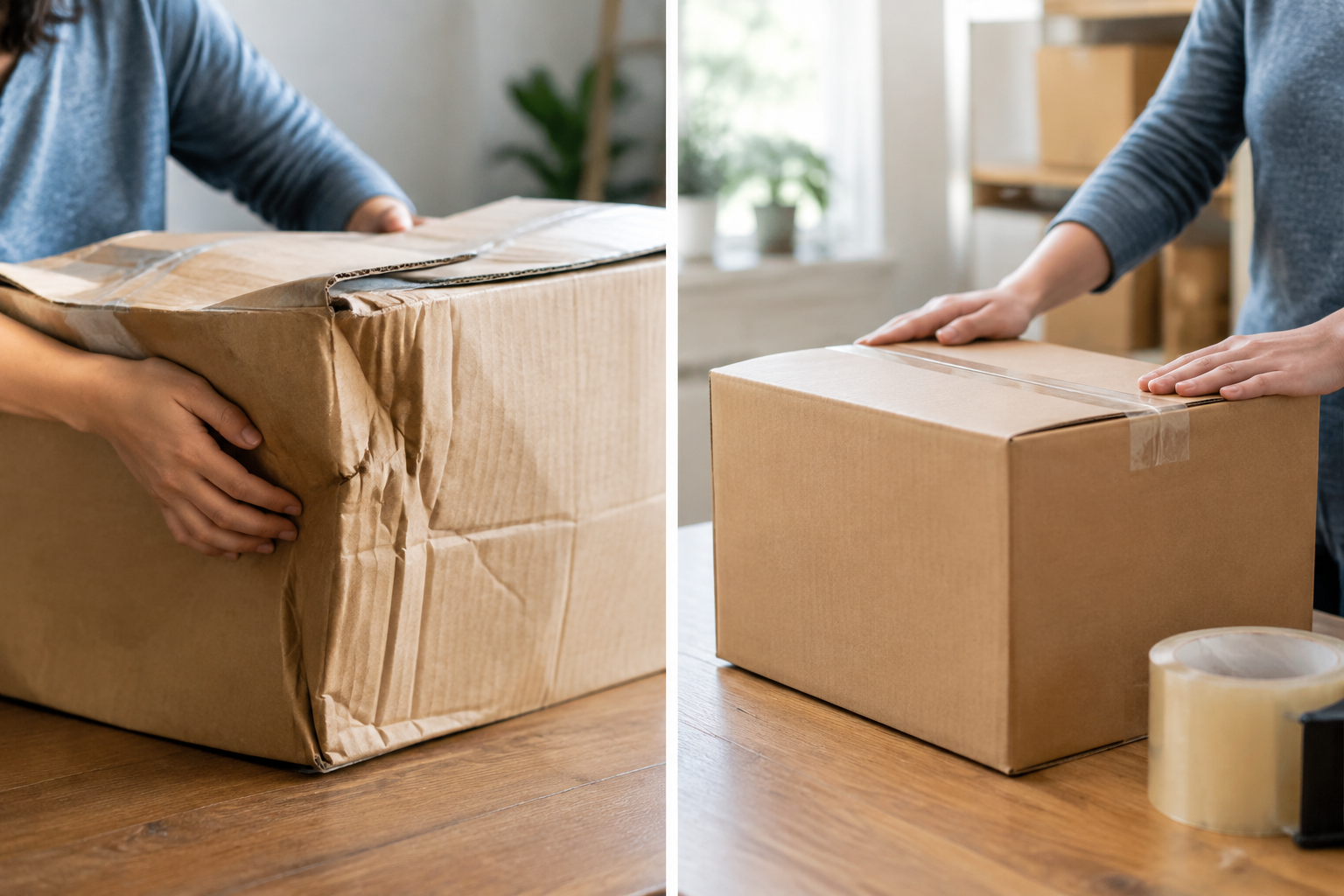
What You'll Need
Gather this stuff before you touch a single flute chart. It takes about 45 minutes, plus a few days if you're waiting on sample boxes.
-
A postal or bathroom scale. You'll weigh each packed order, not just the bare product.
-
A tape measure. Get length, width, and height in inches, always in that order.
-
Your three heaviest products. Pick the worst cases. If those survive, everything lighter will too.
-
Your usual packing materials. Bring the tape, paper, bubble wrap, and inserts you actually ship with. Testing with different padding gives you a false pass.
-
2-3 sample boxes in different flutes. Order a few B-flute and C-flute samples, plus a double-wall option if your orders top 40 lbs. Free samples are the cheapest way to avoid a bad bulk buy.
-
Reinforced packing tape. Regular tape can mask a weak box during testing.
-
A notepad or phone. Jot down weights, box dimensions, and ECT numbers as you go.
-
Skills required: none. If you can read a tape measure, you're set.
Time required: about 45 minutes for measuring, weighing, and picking. Add a few days for samples to arrive, and one more afternoon for the drop and squeeze test.
A 45-pound box of ceramic planters doesn't care how nice your packaging looks. It cares about the flute. Pick the wrong one and the bottom gives out somewhere between the sorting hub and your customer's porch.
That's the mistake most first-time sellers make when they move off retail-store boxes. Cardboard boxes from a big-box shelf look sturdy enough, so they grab a stack and hope. Sometimes it works. Often it doesn't, and one crushed corner turns into a refund, a replacement, and a one-star review (all for a box that cost a couple of bucks).
The fix isn't complicated. Corrugated board comes in a handful of flute types, each built for a different job, and heavy items demand a specific match. Get that match right, and you're not guessing anymore. Weigh your heaviest packed order, read the ECT rating, test a sample, then buy in bulk. Four moves. Done.
What You'll Get Done Here and What You Need Before You Start
A seller packs a 22-pound cast iron skillet set into a box from a retail store shelf, tapes it up, and ships it. Two days later, the bottom has split open, and the customer has a photo of it. That's the exact problem this guide fixes.
What the finished result looks like: a flute, wall type, and box size matched to your heaviest order
One flute (B, C, or E). One wall type (single or double). One size that fits your heaviest order with room for padding. Not a guess. A spec you can reorder without thinking.
Most sellers moving off store-bought cardboard boxes just need a sturdier wall and a tighter fit. That's it.
Gather these first: a postal scale, a tape measure, your three heaviest products, and a few free sample boxes
-
Postal scale: weigh each product packed, not bare.
-
Tape measure: get length, width, and height in inches.
-
Your three heaviest products: these set the bar, so test with them.
-
Free sample boxes: order a few sizes and flutes to test fit before buying in bulk.
Selling something premium? Sample a few black cardboard boxes too, since color changes nothing about strength.
Step 1: Weigh Your Heaviest Packed Order and Sort It Into a Load Class
Guessing weight gets boxes crushed. Grab a scale and weigh your worst-case order, the one that's packed the fullest, before you buy a single flute.
Weigh the product plus the padding, tape, and inserts, not just the item alone
Most first-time sellers weigh the product and stop there. Wrong number. A 38-lb item with dividers, kraft paper, and tape can hit 44 lbs, and that jump changes which cardboard boxes you need. Pack one order exactly as it ships. Then put the whole thing on the scale (a cheap bathroom scale works fine for heavy orders).
Use simple weight bands (under 20 lbs, 20-40 lbs, 40-65 lbs) to pick single-wall or double-wall
Sort that number into a band.
Keep it simple.
-
Under 20 lbs: single-wall B-flute or C-flute handles most orders.
-
20-40 lbs: heavy-duty single-wall C-flute with a higher ECT rating. Go double-wall if the items are dense or stacked.
-
40-65 lbs: double-wall, no debate.
Buying from a wholesale shipping box supplier lets you check the flute — ECT rating before you commit to bulk. Skip thin chipboard cartons for anything in the top two bands. They suit light retail goods, not freight.
Step 2: Match the Flute to How Your Box Will Be Handled and Stacked
Will your box get tossed on a truck, or sit under five others in a garage? That answer picks the flute. Most cardboard boxes fail because of the wrong handling match, not weak paper.
A-flute (1/4"): best cushioning for fragile heavy goods like glass, ceramics, and candles
A-flute is the thickest, so it soaks up bumps. Use it for glass jars, ceramics, and big candles. It crushes easier under stacked weight, though, so ship it single-layer and don't pile it high.
B-flute (1/8"): the standard pick for dense items and crush resistance on a pallet or shelf
B-flute is the workhorse. Its tight flutes resist crushing and take printing well. Books, canned goods, and tools do fine in it. Shop owners wanting a cleaner look can pick white cardboard boxes in the same strength.
C-flute (3/16"): the go-to heavy-duty choice for stacking strength in the garage or warehouse
C-flute splits the difference. It stacks well and still cushions. Anything over 30 lbs or stored long-term belongs here. Double-wall C is the safe call for heavy-duty moving loads.
E-flute (1/16"): thin and good for small mailers, but not for heavy loads
E-flute is slim and prints sharply. Great for small mailers and retail packaging. Heavy loads? No. It folds under weight. For fine graphics, compare it with SBS cardboard boxes before ordering.
-
Fragile and heavy: A-flute
-
Dense and stacked: B-flute
-
Heavy and stored: C-flute
-
Light and small: E-flute
Step 3: Check the ECT Rating and Wall Construction, Then Choose Your Box Size and Quantity
A 32 ECT single-wall box holds roughly 65 pounds.
A 48 ECT double-wall box handles around 100 or more. Most first-time sellers never look at that number, and it's printed right on the box.
Read the ECT number (32, 44, 48) and pair it with single-wall or double-wall board
Flip a box over and find the stamp on the bottom flap. Here's the rule of thumb:
-
32 ECT, single-wall: candles, apparel, books.
-
44 ECT, single-wall: small appliances, canned goods, jars.
-
48 ECT or double-wall: anything past 50 pounds, or stacked inventory.
For anything dense, heavy duty boxes with a higher ECT are the safer call. Don't guess.
Measure the product, add 1-2 inches per side, and order sizes in the 2-3 you actually use
Measure length, width, and height. Add 1-2 inches to each for padding. That's it. Then look at your last 50 orders and pick the two or three sizes that cover most of them (stocking ten sizes just buries your garage in cardboard boxes).
Start with a bundle of 25-50, test the boxes, then buy in bulk once they hold up
Order a small bundle first. Pack real products, tape them, and drop one from waist height. Did the corners survive? Good. Now buy 250 or 500 and enjoy lower per-box rates.
Step 4: Test Your Pick Before You Buy in Bulk, and Fix Common Mistakes
A spec sheet won't tell you if a box works. That's the myth. ECT numbers and flute charts get you close, but only a real test proves it. Twenty years on a warehouse floor taught one thing: the box that looks fine on paper fails at the dock.
Run a simple drop and squeeze test with the real product, packed and taped
Order a few single samples first. Pack each with the actual product, fill the voids — seal it the way you'll ship.
-
Drop it from waist height onto a hard floor: flat, on an edge, and on a corner.
-
Squeeze it. Press hard on the sides and top. Walls shouldn't bow.
-
Stack it. Set 30-40 pounds on top overnight. Sagging means you need a stronger flute.
-
Open it. Check the product and the seams.
Mistakes to avoid: buying retail-store boxes by looks, oversized boxes with too much void fill, reused boxes with soft walls, and skipping reinforced tape on heavy loads
-
Buying by looks. A thick-feeling store box can still be weak single-wall.
-
Going oversized. Extra void fill shifts and compresses. Keep 1-2 inches of room per side.
-
Reusing tired boxes. Soft walls lose most of their stacking strength.
-
Skipping reinforced tape. Heavy loads need filament or water-activated tape on every seam.
Short on padding? Cut cardboard sheets into dividers and layer pads. They stiffen the load for almost nothing.
Step 5: Confirm the Result Is Right and Plan Your Reorders
A seller on Etsy ships her first 50 candle orders in B-flute boxes, then opens her inbox on day ten. Zero complaints. That quiet inbox is the test result you want.
Signs the flute choice worked: no crushed corners, no bulging sides, no damage claims after your first 50 orders
Pull two or three returned or test-packed cardboard boxes and inspect them. Check these:
-
Corners: no dents or flattened edges.
-
Side walls: no bowing when the box sits on a shelf.
-
Seams and tape: nothing peeling or split.
-
Claims: none tied to crushing.
Bulging sides? Step up to C-flute. Crushed corners on stacked orders? Look at a higher ECT rating or double-wall.
Where to get samples, source single boxes, and set a reorder point so you never run out mid-week
Order samples before you commit to a big bundle.
A white cardboard box sample also shows you how a clean exterior takes labels — stamps. Need just one? Buy a single box to test-pack your heaviest item first.
Now the reorder math. Say you ship 100 orders a month and delivery takes a week. Set your reorder point at 40 boxes per size (a week and a half of cover, plus a cushion). When the stack hits that line, you order. No guessing, no scrambling.
How-To FAQ
Which flute is best for cardboard boxes carrying heavy items?
C-flute is the best all-around pick for heavy items, because it stacks well and resists crushing. If the load is fragile as well as heavy, go with A-flute for extra cushioning. For anything over 40 lbs, pair your flute with double-wall board. Don't rely on the flute alone.
Is single-wall or double-wall better for heavy boxes?
Double-wall is the safer choice once a packed box passes about 40 lbs. Single-wall with a C-flute handles most loads under 40 lbs just fine. Double-wall costs a little more per box, but one crushed shipment wipes out that difference fast.
Can I use E-flute boxes for heavy products?
No. E-flute is too thin to carry heavy loads. It's great for small mailers, printed boxes, and light products like cosmetics or accessories. Put a candle set or a few ceramic mugs in one and the walls will bow within a day or two of stacking.
How do I know if my box is strong enough before ordering in bulk?
Order a free sample and test it with your real product, packed and taped. Here's the quick routine:
-
Pack the box exactly as a customer would receive it.
-
Drop it flat, then on one corner, from about 3 feet.
-
Press down on the top with your full body weight for 10 seconds.
-
Check for bulging sides, split seams, or crushed corners.
If it passes, buy a bundle of 25-50 before committing to a bigger order.
What ECT rating do I need for heavy items?
Look for ECT 32 for light loads, ECT 44 for most heavy items, and ECT 48 or higher for very heavy or stacked shipments. ECT stands for Edge Crush Test. A higher number means the walls resist crushing better. Check the rating listed with each box before you buy.
Do I need reinforced tape for heavy boxes?
Yes, use reinforced tape on any box that weighs more than about 30 lbs. Standard tape can peel or split under load, and the bottom seam is where most heavy boxes fail. Apply the tape in an H pattern across all seams, then run a second strip across the bottom.
Heavy shipments fail for predictable reasons.
The box was too weak for the load, the flute didn't match how it got stacked, or nobody tested it before the order went out. Each of those problems is fixable with a scale, a tape measure, and an afternoon.
A seller who weighs the fully packed order first can sort it into single-wall or double-wall board without guessing. From there, the flute follows the handling: C-flute when boxes sit in stacks, A-flute when the contents need cushioning, B-flute for dense goods that mostly need crush resistance. The ECT rating then confirms the board can carry the weight. Right-sized cardboard boxes with reinforced tape finish the job, and a drop test with the real product shows whether the pack holds up.
Skip the bulk order until the sample passes.
Buying 25 to 50 boxes costs little, and the first 50 shipments will show whether corners stay square and sides stay flat.
Next step: order free samples in two sizes and two flute types, pack your heaviest product in each, and run the drop and squeeze test this week. Buy in bulk only after one of them survives.
UCANPACK
753A Tucker Rd
Winder, GA 30680
1 201-975-6272
https://ucanpack.com


